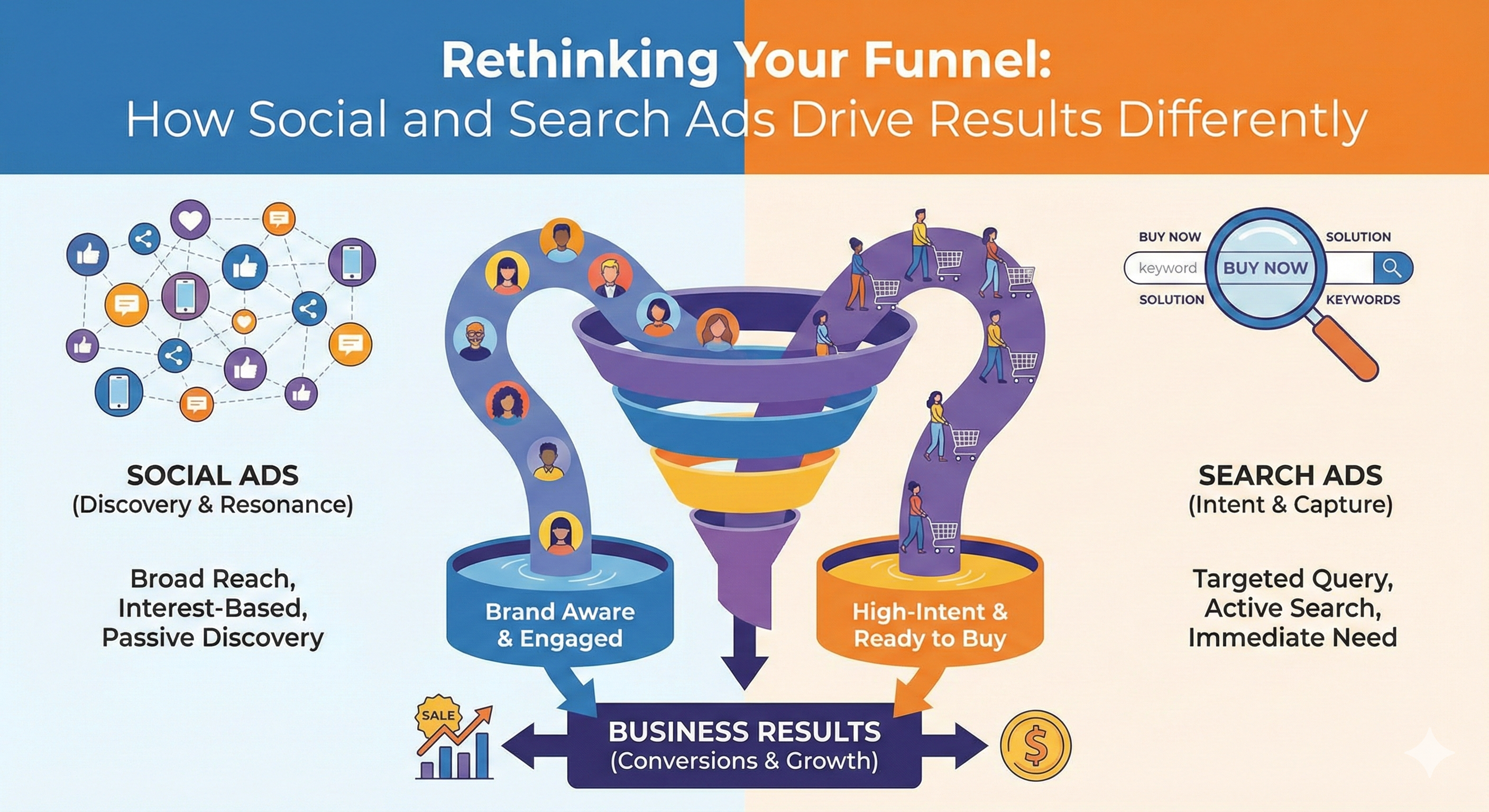
Rethinking Your Funnel: How Social and Search Ads Drive Results Differently
Terms like “top of funnel,” “middle of funnel,” and “bottom of funnel” are often used as if they carry the same meaning across all marketing channels—but they don’t.
Funnel stages function very differently on Google Search compared to platforms like Meta, LinkedIn, or TikTok. The intent-driven nature of search doesn’t align with the audience-based logic of social platforms, and applying one framework to the other can produce misleading results.
This piece explains the core differences between search and social advertising, why traditional funnel models fall short on social channels, and what strategic approaches deliver better outcomes.
The Problem: Applying Search Funnel Logic to Social Platforms
The problem is we apply search funnel logic to social platforms—a framework that doesn’t translate directly.
In traditional marketing funnels, audiences are grouped by intent:
Top of Funnel (TOFU)
Individuals who recognize a problem but aren’t aware of specific solutions or brands. For example: “How to improve my sales performance” reflects top-of-funnel curiosity.
Middle of Funnel (MOFU)
Individuals who understand potential solutions and are comparing different options. For example: “How to hire a digital marketer” indicates middle-of-funnel consideration.
Bottom of Funnel (BOFU)
Individuals who are ready to purchase and are evaluating particular brands or platforms. For example: “Best places to hire digital marketers” signals bottom-of-funnel purchase intent.
This model works naturally within search advertising, where each query expresses a clear level of intent.
Because every search query reveals what the user wants, audience segmentation is straightforward.
Social platforms, however, operate differently—ads appear within attention streams rather than intent-driven searches, which means the funnel model doesn’t apply in the same way.
Social Ads Lack a Dependable Intent Signal

Ad targeting on platforms like Meta, LinkedIn, and TikTok isn’t driven by intent—it’s driven by demographics and psychographics. You can target segments such as:
- Start-up founders of companies with 10–50 employees
- People interested in digital marketing and growth
- Lookalike audiences modeled after your best customers
But none of these parameters reveal what someone intends to do at that moment.
For example, a founder scrolling through LinkedIn might be in the process of hiring a growth marketer, might have just completed that hire, or might not plan to at all. The advertiser doesn’t know, the platform doesn’t know, and even the user might be uncertain about their next steps.
When marketers describe “top,” “middle,” and “bottom” of funnel activity on social media, they’re using approximations based on indirect signals:
Top of Funnel
Broad, cold audiences unfamiliar with your brand. These can include millions of users—some may have purchase intent, but most do not.
Middle of Funnel
Lookalike or engaged audiences who resemble your customers or have interacted with your content. The resemblance suggests potential interest, but still offers no concrete sign of intent.
Bottom of Funnel
Retargeting audiences who have visited your website, watched a video, or otherwise engaged with your brand. While they’re aware of you, awareness doesn’t necessarily mean readiness to buy.
Ideally, funnel stages on social platforms serve more as organizational labels than true indicators of where a buyer stands in their decision-making journey.
Why This Breaks Traditional Funnel Logic
Many founders and marketers design their marketing as:
- Run top-of-funnel ads to build awareness
- Capture leads or email sign-ups
- Nurture those leads through a content or email sequence
- Drive conversions through retargeting
This approach works well when intent is explicit—as it is in search advertising. A user searching “best CRM for small business” signals active evaluation, allowing you to align messaging and nurture sequences with that buying timeline.
Social advertising, however, operates under different dynamics. When you show ads to a broad audience, intent is unevenly distributed:
- About 1–2% have high intent and are ready to buy now
- Around 10–20% have moderate intent and may convert after several interactions
- The remaining 80–90% range from mildly curious to entirely unready
Treating everyone the same leads to inefficiency—you’ll over-nurture those ready to buy and under-nurture those who needed more time. Traditional funnels assume prospects move neatly through stages; social ads assume audiences are scattered across invisible timelines.
What Actually Happens When Someone Sees Your Social Ad
High Intent (1–2%)
These users already feel the pain, are seeking a solution, and encounter your ad at the right moment. They convert quickly, with little extra effort.
Moderate Intent (10–20%)
They notice your ad but need validation. They might explore your website, read a case study, or engage with a retargeting ad before deciding. Multiple touches lead them to convert.
Low or Future Intent (80–90%)
They may scroll past, click idly, or have no need right now. Retargeting them heavily wastes budget; ignoring them entirely risks losing recognition when they are ready.
The key is that you can’t know which segment a person belongs to at first exposure. Your best tactic is to deliver a strong ad to a large, relevant audience, let high-intent users reveal themselves through action, and maintain visibility for everyone else until their timing aligns.
Why Simple Beats Overengineered Nurture Funnels
Many founders overcomplicate early campaigns—designing elaborate drip sequences, multiple retargeting layers, and gated lead magnets—before validating the core offer. None of this matters if the initial ad fails to grab the attention of the 1–2% ready buyers.
The highest-leverage move is to perfect your top-of-funnel ad. When your ad resonates:
- High-intent users convert immediately
- Moderate-intent users engage, research, and convert later
- Low-intent users ignore it or remember it for the future
Conversely, a weak ad fails across the board—it misses ready buyers, attracts poor-fit audiences, and fills your retargeting pool with unqualified leads.
In social advertising, success doesn’t come from forcing users through a rigid funnel—it comes from staying consistently visible as their own buying timeline aligns with your offer.
Here’s what most marketers and founders go wrong: they prioritize elaborate nurture sequences—such as seven-day email drips and multi-segment retargeting—before confirming their primary offer resonates with the market.
If your top-of-funnel ad can’t convert 1-2% of high-intent leads then no amount of nurturing will help.
Getting the Top-of-Funnel Ad Right Is Your Highest-Leverage Move
The Impact of Ad Quality:
Strong Messaging:
- High-intent users convert immediately
- Moderate-intent users engage and convert after subsequent touches
- Low-intent users remain aware for future needs
Weak Messaging:
- High-intent users are missed due to poor alignment
- The wrong audience is attracted
- Retargeting pools become diluted with low-quality leads
The most effective strategy is to deploy a high-quality ad to identify existing market intent, then use visibility to stay top-of-mind until the remaining audience is ready to purchase.
A Data-Driven Model for Social Ad Funnels
On social platforms, intent signals are often opaque. Instead of traditional “stages,” consider this model based on awareness and resonance:
1. Top of Funnel (The Testing Ground)
Goal: Validate message resonance and identify “hand-raisers.”
Audience: Broad or interest-based (cold traffic).
Success Metric: Immediate conversions from a small percentage and high engagement (clicks/views) from the rest.
Key Insight: This is an exploratory phase. High conversion rates across the board are unlikely; you are searching for a specific “signal.”
2. Middle of Funnel (Statistical Relevance)
Goal: Maintain visibility among those statistically likely to buy.
Audience: Lookalikes or individuals who engaged but did not convert.
Success Metric: A slight lift in conversion rates compared to cold traffic.
Common Pitfall: Treating these as “warm leads.” Most still lack immediate intent but share traits with those who do.
3. Bottom of Funnel (Brand Awareness)
Goal: Capture conversions from those waiting for the right timing.
Audience: Previous website visitors and active content engagers.
Success Metric: Higher conversion rates achieved over a longer time horizon.
Key Insight: These users are brand-aware, not necessarily “ready.” Success here is a game of persistence and timing.
Structural Roadmap for Ad Strategy
To build a sustainable funnel, follow this sequence to ensure you are investing in proven concepts:
Iterative Concept Testing
Run 5–10 different ad concepts (hooks, angles, and value props) to broad audiences. If a message converts 1–2% of cold traffic profitably, you have found your “signal.”
Simplified Retargeting
Once traffic is flowing, implement a basic retargeting layer. Re-expose site visitors to your best-performing ads or social proof. Avoid over-engineering these sequences.
Temporal Consistency
Understand that conversion timelines vary. Maintain your top-of-funnel volume to feed the system and let retargeting capture the lagging conversions.
Strategic Complexity
Only add lead magnets, segmented sequences, or complex gating after you have data proving that the core messaging works.
Quick Diagnosis: Is Your Funnel Too Complex for Social Ads?
If you answer “Yes” to these questions, your strategy may benefit from simplification:
Is there a barrier before the core offer? If high-intent users must pass through a lead magnet or long email chain to buy, you are likely losing immediate revenue.
Is performance identical across all stages? If your “Bottom of Funnel” performs no better than “Top of Funnel,” your segmentation isn’t actually identifying intent.
Are you prioritizing “nurture” over “visibility”? Social media users often convert on their own timeline. Constant visibility is usually more effective than an artificial 14-day sequence.
Are retargeting expectations unrealistic? If retargeting isn’t “making money,” it’s likely because those users are simply aware of your brand, not yet ready to buy. Adjust your timeline expectations accordingly.
Download the Full Guide
Want to keep this guide handy? Download the complete PDF version:
📄 Download: Social Ads vs Search Ads Guide (PDF)
Have questions about your social ad strategy? Feel free to reach out for a consultation.